
Stop Deer Eating Your Garden: West Sussex Spring Guide
Spring brings new growth — and hungry deer. Practical advice for homeowners in Horsham, East Grinstead, Crawley and across West Sussex.
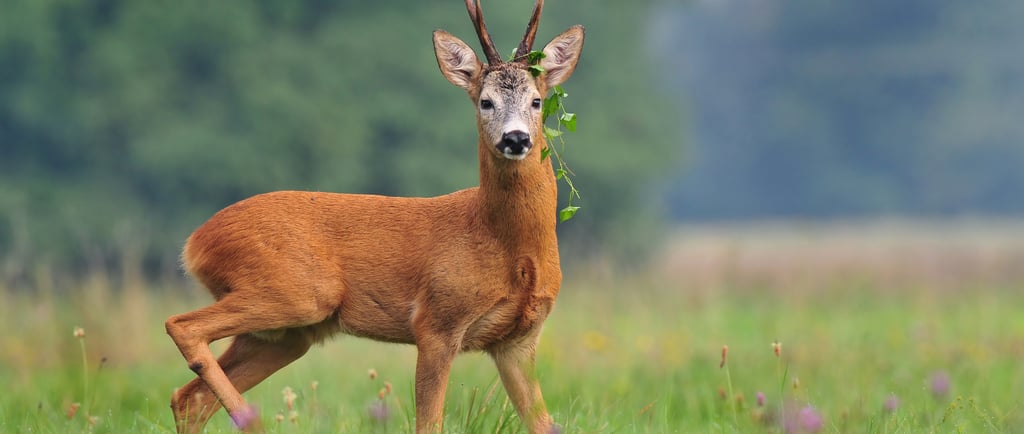
If you've stepped out into your West Sussex garden this April or May and noticed neat little bites taken from your roses, your hostas mowed flat, or the leading shoots stripped from your young trees, you're almost certainly dealing with deer.
Spring is the season when garden damage spikes. Lush new growth, hungry deer emerging from a lean winter, and the start of fawning season all combine to push deer into more visible browsing patterns. At Deer Services UK we cover much of West Sussex, including Horsham, East Grinstead, Crawley, Rusper and the surrounding High Weald villages and spring is when our phone tends to start ringing.
Here's what's going on, and what you can practically do about it.
Why deer damage peaks in spring
Through winter, deer get by on coarse browse — bramble, ivy, evergreen leaves and tree bark. When spring growth arrives, that menu changes overnight. Suddenly there's:
Soft, protein-rich new shoots emerging on shrubs, hedgerows and young trees
Tulips, hostas, roses and other ornamentals breaking ground (deer favourites, all of them)
Vegetable beds being planted out
Field crops and pasture greening up — drawing deer into closer movement patterns
At the same time, fawning and calving season runs through May and June. Pregnant does often shelter in quiet woodland edges and hedgerows close to houses, which means more deer movement near gardens at exactly the moment your planting is most vulnerable.
Which deer is in your garden?
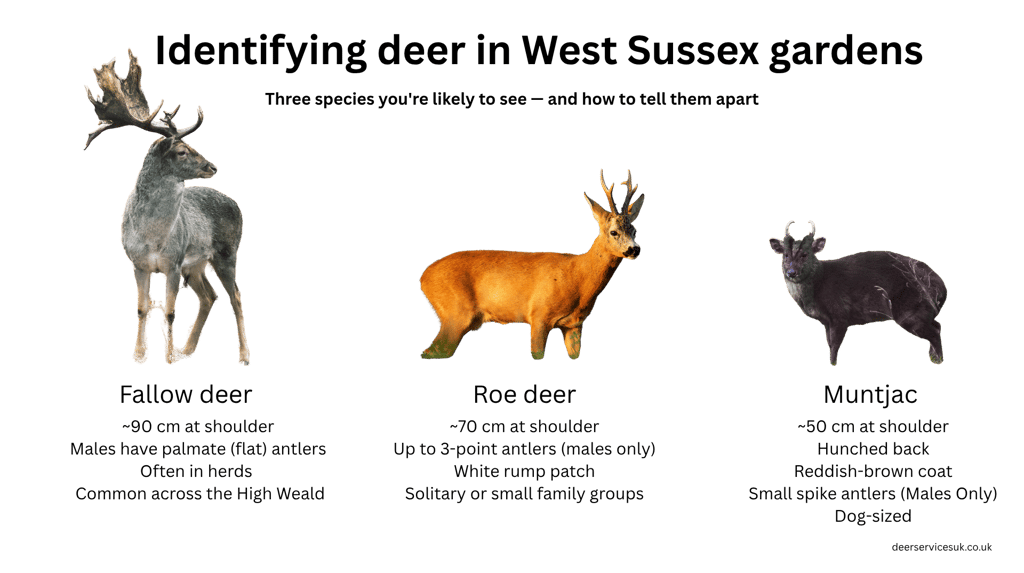
Across West Sussex you're most likely dealing with one of three species — and it matters which, because their height, jumping ability and feeding patterns differ:
Fallow deer — the largest you'll commonly see, often in herds. Heavy browsers with a real appetite for hedgerow and shrub growth. Common across the High Weald, around estate land, and increasingly along the suburban fringes near Crawley, East Grinstead and Horsham.
Roe deer — solitary or in small family groups. Smaller, but very destructive in gardens because they're nimble, curious, and quite happy to nibble their way around bedding plants and rose buds.
Muntjac — small, stocky, often mistaken for a large dog at first glance. Expanding rapidly across the South East. They squeeze through gaps you wouldn't believe possible.
The British Deer Society has a useful identification guide if you're not sure: https://bds.org.uk/information-advice/about-deer/deer-species/
A practical spring checklist for West Sussex homeowners
Before reaching for any "miracle" repellent (most are short-lived at best), work through these in order:
Walk your boundary. Look for gaps in hedges, broken fence panels, hoof prints in soft ground, or smoothed-down "creep" routes through gaps. Muntjac in particular use the same pinch points repeatedly.
Look for signs, not just sightings. Deer are most active at dawn and dusk and you may never see them in the act. Look instead for browsed shoots (a torn, ragged edge rather than a clean cut suggests deer rather than rabbits or scissors), droppings, hoof prints, and bark stripping on young trees.
Protect what you can immediately. Spiral or mesh tree guards on young trees, temporary netting over vegetable beds, and physical barriers around prized roses or fruit trees will buy you time while you plan a longer-term approach.
Choose plants wisely going forward. Lavender, rosemary, foxgloves, daffodils, alliums and most ferns are generally left alone. Roses, hostas, tulips, fruit trees and most soft-leaved ornamentals are deer magnets. Replanting beds with deer-tolerant species is one of the most cost-effective long-term solutions.
Think about fencing properly. A short ornamental fence stops nothing. Effective deer fencing is typically 1.8m+ for fallow and red, and needs to go right to ground level (with no gaps) for muntjac. Half-measures rarely pay off.
Get a professional assessment if damage is ongoing. Persistent deer pressure usually indicates a wider population issue beyond your boundary — and that's not something a bottle of repellent will solve.
When to call us in
If you've tried the basics and the damage is still happening, or if you're managing more than just a domestic garden such as paddocks, smallholdings, woodland, larger estates — it's worth getting a proper site assessment.
We work with clients across Horsham, East Grinstead, Crawley, Rusper and surrounding villages on practical, ethical deer management — including site assessment, fencing recommendations, and where appropriate, sustainable population control. Every situation is different, and the right answer for a half-acre garden in Rusper isn't the same as the one for a 200-acre estate near East Grinstead.
📩 Want to talk it through? Email contact@deerservicesuk.co.uk or visit our Services page to learn more about what we offer.